Wired at £350 vs Wire-Free at £650: Which One Is Really Worth Your Money?
By Le Coin Vert
.png&w=3840&q=75)
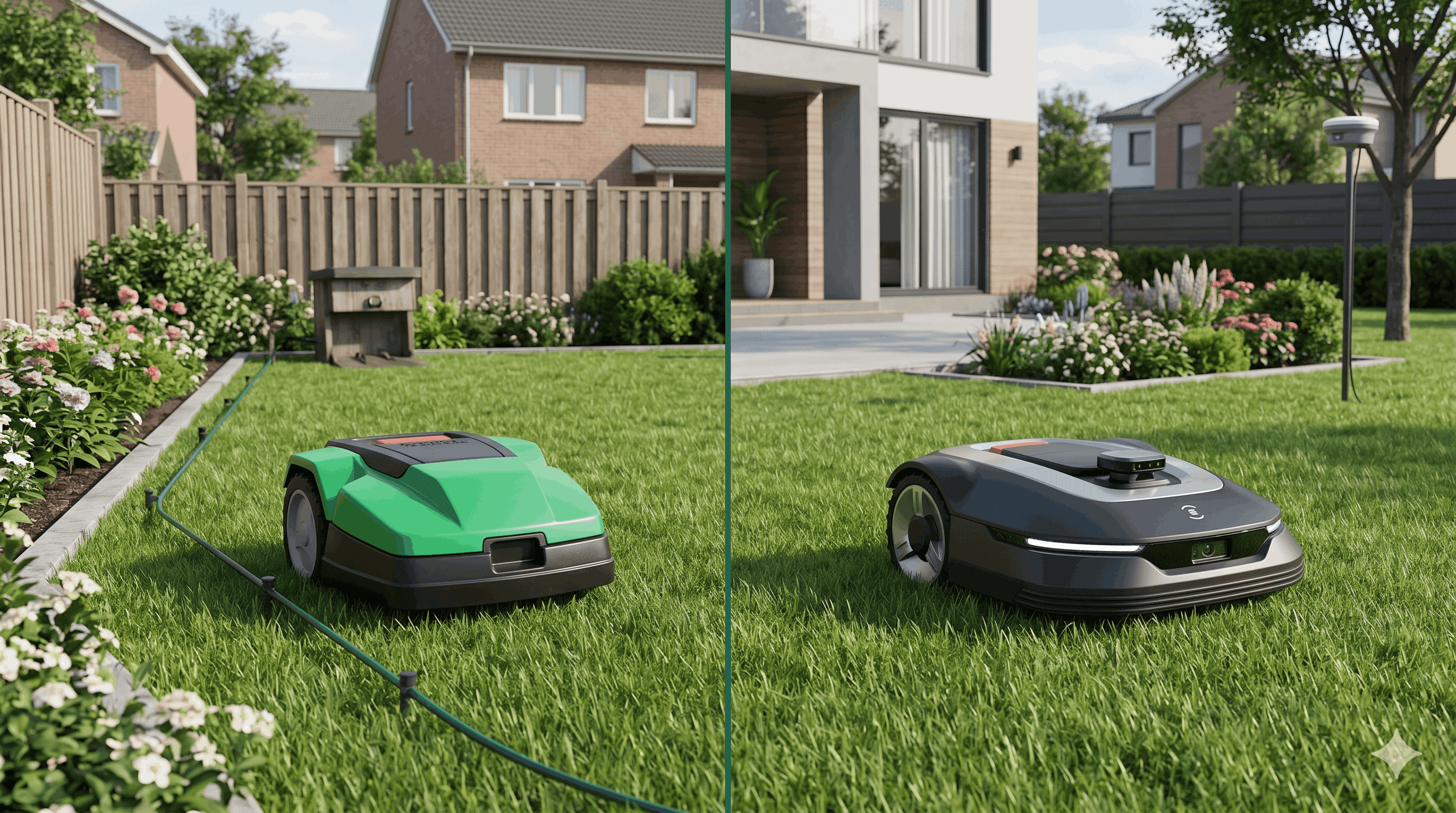
A wired robot mower at £350 and a wire-free model at £650. The £300 gap looks straightforward. What the comparison consistently ignores: installing a perimeter wire costs between £100 and £250 in materials alone, plus 6 to 8 hours of work if you do it yourself, or £200 to £400 in labour if you hire a professional. And the wire breaks.
The Real Comparison: Total Cost of Ownership Over 4 Years
Here are the numbers laid out properly.
Budget wired robot mower:
- Purchase price: £350
- Wire installation (materials): £150
- Wire laying (2 half-days of personal labour, valued at average hourly rate): £120
- Wire repairs over 4 years (average: 1.5 breaks per year at £45 in time and materials per repair): £270
- Blade replacement over 4 years: £80
- 4-year total: £970
Mid-range wire-free robot mower:
- Purchase price: £650
- Installation (30 minutes, placing the dock, no wire to bury): £0
- Repairs over 4 years (no wire, zero breaks): £0
- Blade replacement over 4 years: £80
- 4-year total: £730
The wire-free model at £650 costs £240 less over 4 years than the wired model at £350. The wired model's price advantage is an accounting illusion that does not survive a complete analysis.
Which model fits your real budget?
The simulator calculates total cost based on your garden size and constraints.
What the Wire Costs in Time
The financial value of time spent maintaining the perimeter wire is invisible because no invoice materialises it. A wire break on a 300 m² garden takes an average of 90 minutes to locate and repair. One break per year over 4 years: 6 hours. Two breaks per year: 12 hours.
Those hours are spent on your knees in the garden with a wire detector, not enjoying the lawn the robot is supposed to maintain for you. The opportunity cost of those hours is real, even if no bank statement reflects it.
When Wired Still Makes Sense
A perimeter-wire robot is not always the wrong choice. It remains relevant in three specific scenarios.
A perfectly open garden with clear sky, flat terrain, and no trees, where the wire is unlikely to be damaged by gardening work: a modern wired model will run reliably and maintenance costs will stay low.
A genuinely tight purchase budget under £400: if the initial investment is the hard constraint and you accept the maintenance cost ahead, wired remains accessible.
A garden with very complex topology involving multiple narrow grass islands where some wire-free models struggle with mapping: in this specific case, wired navigation logic can be easier to configure.
When Wire-Free Is the Only Rational Choice
For gardens surrounded by walls (RTK unusable), slopes above 25%, gardens with frequent replanting that threatens the wire, and for anyone who has already suffered two or more wire breaks on a previous model: wire-free is the only economically rational option.
Wired vs Wire-Free: Budget Comparison 2026
 |  |  | |
|---|---|---|---|
| Max area | 300 m² | 500 m² | 800 m² |
| Max slope | 35% | 30% | 80% |
| Wire-free | |||
| GPS / RTK | |||
| Cut-to-Edge | |||
| App control | |||
| Check price | Check price | Check price |
The Worx Landroid S300 is the best representative of entry-level wired: reliable, simple, effective on small flat lawns up to 300 m². At £300-350, it is the honest starting point for small gardens without constraints.
The Segway Navimow i105E at £650-750 is the relevant wire-free entry point. GNSS+VSLAM, zero wire, 30-minute installation, plots up to 500 m².
The Mammotion Luba Mini AWD 800 at £800-900 is the wire-free choice for more complex gardens or moderate slopes, with AWD and LiDAR navigation.
Wired vs Wire-Free: Total Cost Verdict
Pros
- Wire-free: lower 4-year total cost in the majority of cases
- Wire-free: 30-minute installation with no materials
- Wire-free: zero wire breaks to repair
- Wired: accessible purchase price under £400
Cons
- Wire-free: higher upfront investment
- Wired: maintenance cost grows significantly over time
- Wired: RTK unavailable in enclosed gardens
- Wired: costly to reconfigure when garden changes
Frequently Asked Questions
Is a wire-free robot mower actually cheaper than a wired model?
How much does it cost to install a wired robot mower?
Can I switch from a wired to a wire-free robot without replacing the charging station?
Read also
.png&w=3840&q=75)
May 19, 2026
Small Urban Gardens: Which Wire-Free Robot Mower to Choose in 2026?
High walls, narrow paths, and a patio taking up half the garden. Urban lawns are the hardest terrain for robot mowers. Here is which navigation technology actually works when the sky is blocked.
May 5, 2026
Replacing Your Boundary Wire Robot Mower with a Wire-Free Model: The Transition Guide
The installation took a full weekend and cost 200 euros. Three years later you have repaired the wire four times. Here is how to move to a wire-free model without repeating the same headache.
.png&w=3840&q=75)
May 3, 2026
Winterising and Maintenance: 5 Steps to Double the Lifespan of Your Robot Mower
Most robot mower failures do not happen during the mowing season. They happen after a bad winter storage. Here is how to avoid the most costly mistakes.