How to Automate Old Garden Spots Without Changing Everything?
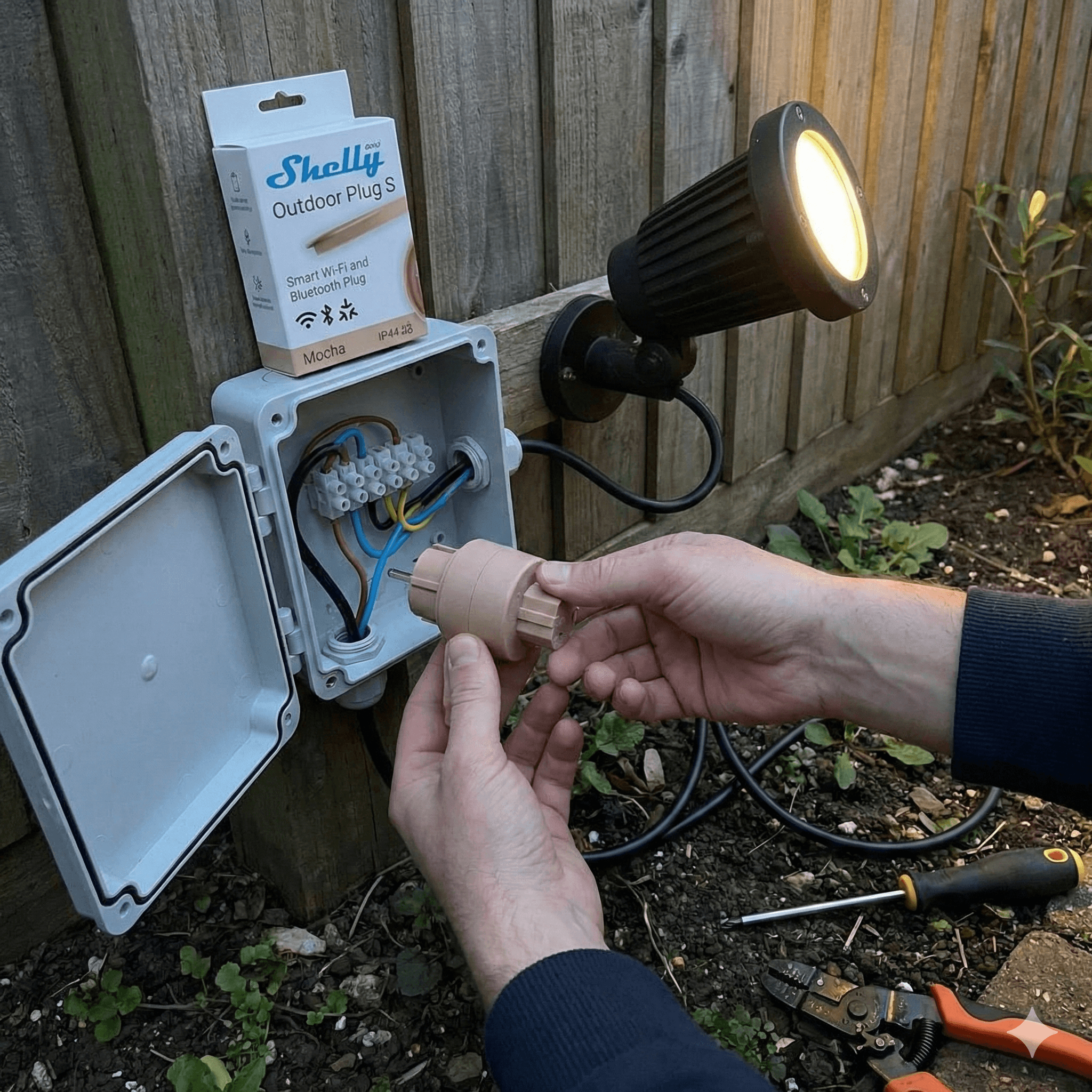
Automating Outdoor Lighting with Shelly: A Practical Guide
You may have invested, perhaps ten years ago, in magnificent lighting to enhance your garden. These halogen spots or LED bollards, faithful to the post, are controlled by a good old mechanical switch located in the living room or garage. Yet, in the era of everything connected, you dream that they light up automatically at dusk or to be able to turn them off with a simple voice command from your bed.
Faced with this need, the usual marketing reflex is to suggest you "replace everything with Philips Hue". It is often a costly and technically hazardous mistake. Imagine having to change ten bulbs: the bill explodes, and you risk facing Wi-Fi or Zigbee range problems once the bulbs are installed outside, far from your router. Fortunately, there is a professional, invisible, and economical solution: the micromodule.
The Shelly solution: Discrete intelligence
The idea is simple but brilliant: rather than changing the bulbs, we are going to make the switch smart. For this, our secret weapon is a small module from the brand Shelly (notably the Shelly Plus 1 or the 1PM). This small box, often red or blue and costing barely twenty euros, fits discreetly into your walls to modernize your installation without breaking anything.
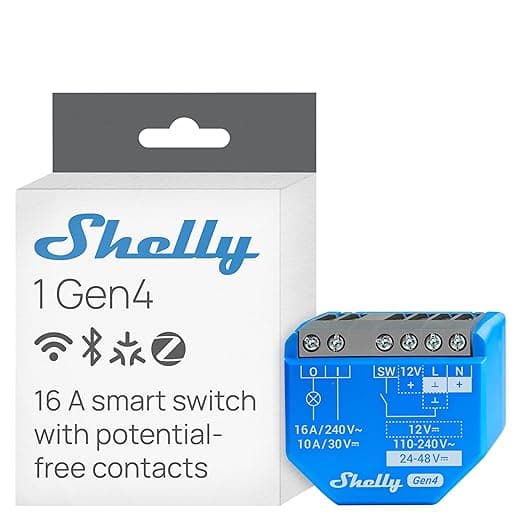
Shelly Plus 1
Le micromodule relais Wi-Fi et Bluetooth pour domotiser n'importe quel éclairage extérieur existant.
Affiliate link. Price remains the same for you.
How does it work?
The operating principle is that of a smart "bridge". The module is generally installed behind your existing switch, at the bottom of the wall mounting box, or directly in the junction box that powers the outdoor line.
Once in place, it acts like an invisible conductor. On one side, it remains connected to your classic physical switch, allowing you to keep your manual habits (which is crucial for the WAF - Woman/Wife Acceptance Factor). On the other, it connects to your Wi-Fi network to receive orders from your smartphone, a time schedule, or presence detectors. It then decides to open or cut the current to your spots, obeying indifferently the physical button or the digital command.
Installation: What you need to know
Attention: Electrical Safety You are going to intervene on 230V current. It is imperative to cut the general circuit breaker before opening any socket. If the terms "Phase" and "Neutral" seem foreign to you, do not take risks and call a qualified electrician.
To function, the Shelly module needs to be powered permanently. It therefore needs the Phase (L) and the Neutral (N). This is often the blocking point in old French installations where the switch only cuts the phase and where the neutral goes directly to the luminaire. If the neutral is absent behind your switch, you will have to pick it up from a nearby power outlet, or choose to install the remote module at the level of the luminaire itself. You will then have to connect the lamp return (O) to your spots and link the switch (SW) to the module to keep the manual control.
Why the micromodule buries connected bulbs
The choice of the micromodule presents four major advantages that make it the queen solution of renovation.
Firstly, reliability. If your Wi-Fi fails, your wall switch continues to work perfectly. You will never be plunged into the dark because of a computer bug.
Secondly, range. The module being often located inside the house (behind the switch overlooking the terrace), it captures the router's Wi-Fi perfectly. It is much more reliable than a connected bulb located at the bottom of the garden behind a brick wall.
Thirdly, economy. A single module at 18€ is enough to control an entire line of 10 or 20 spots. With connected bulbs at 30€ each, I let you calculate the savings made...
Finally, aesthetic freedom. You are not limited to the models of connected bulbs available on the market. You can choose any designer, vintage, or specific luminaire in your favorite DIY store, without worrying about its compatibility with your iPhone.
Conclusion
The use of micromodules like those from Shelly represents the very essence of sustainable home automation: bringing intelligence and comfort to the existing, without generating unnecessary waste or superfluous expenses.