Camera Vision vs LiDAR: The Ultimate Showdown of 100% Autonomous Robot Mowers
By Le Coin Vert
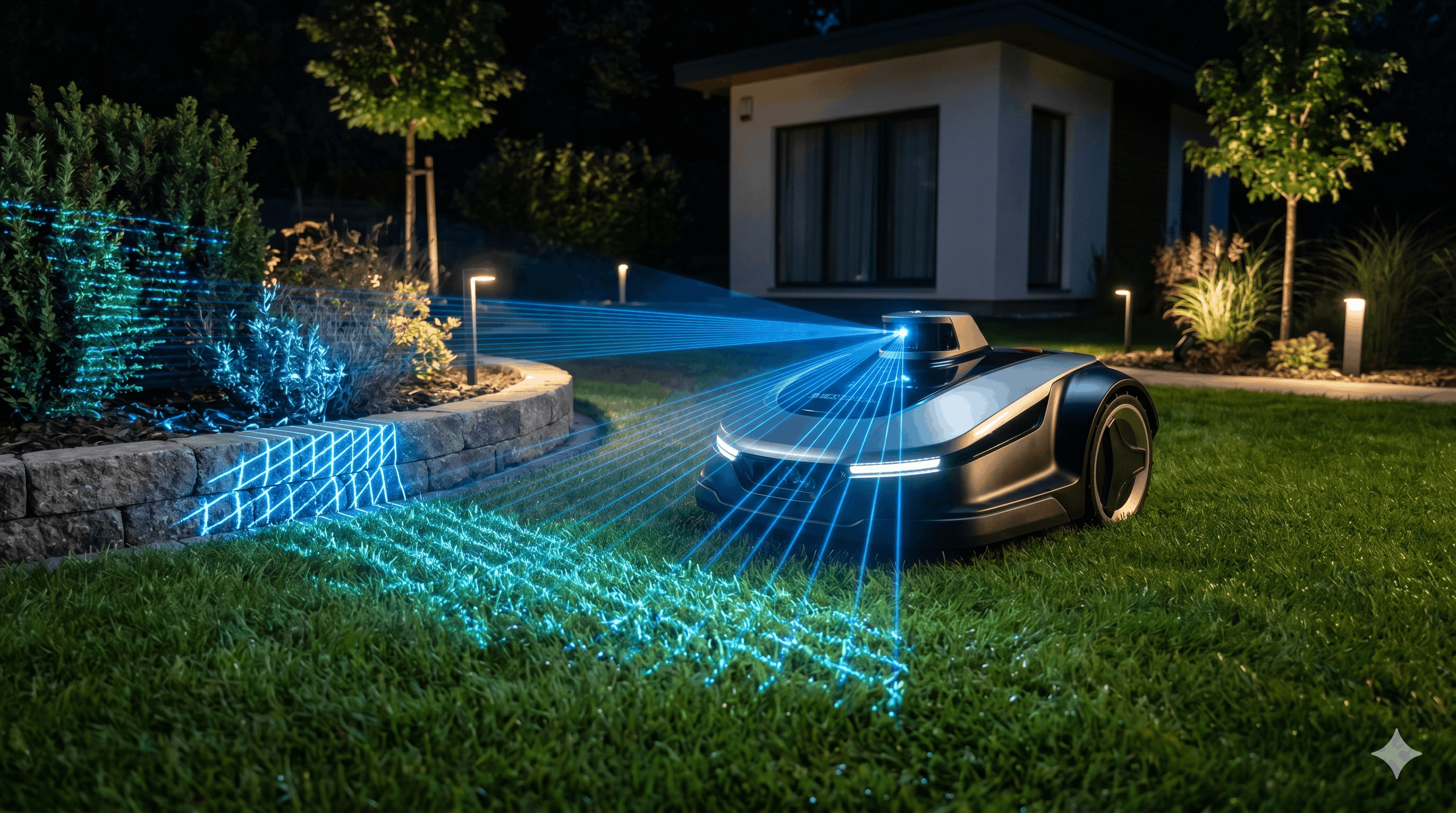
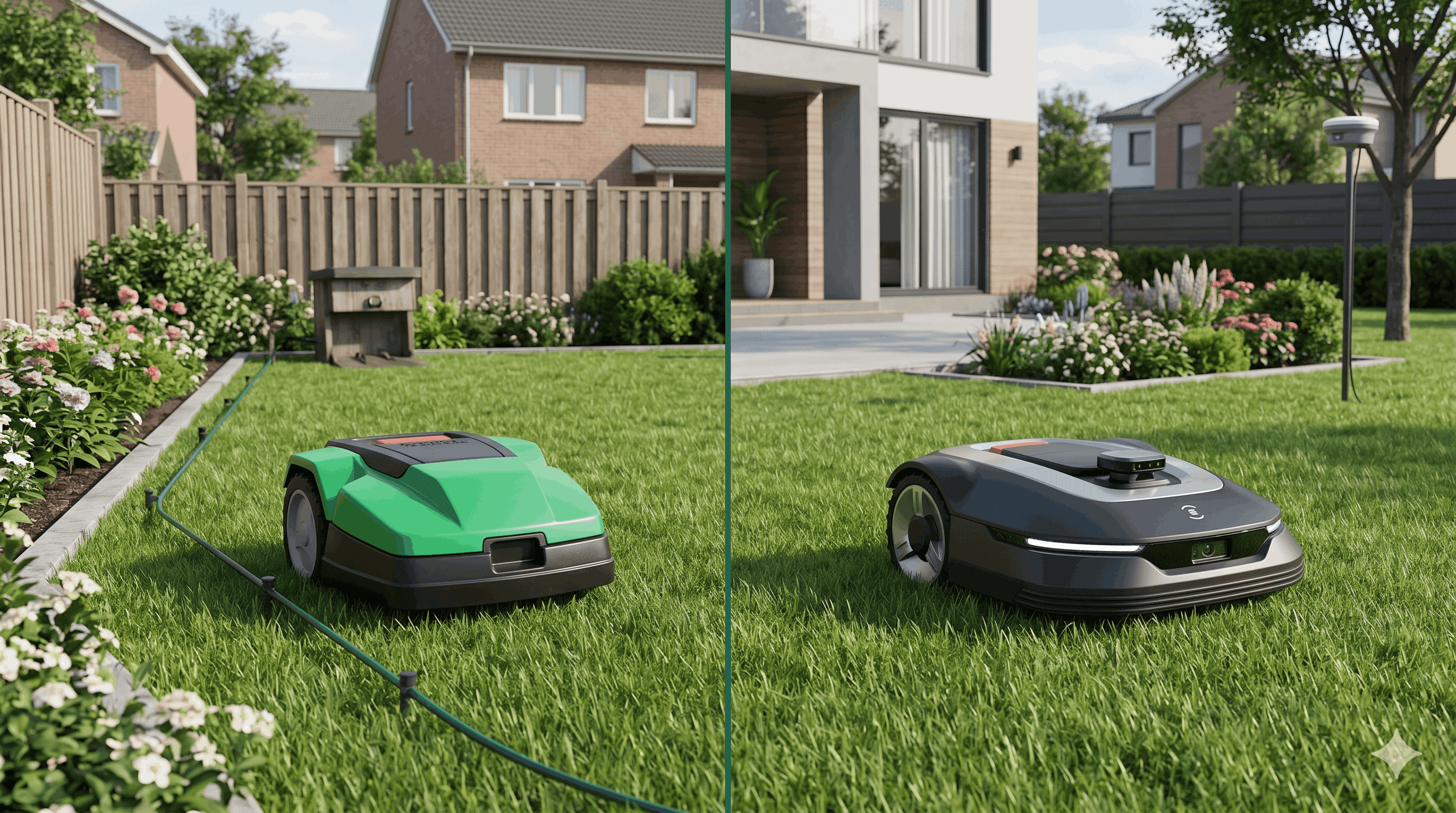
Wire-free robot mowers that navigate without burying a perimeter cable all use one of two sensor approaches: LiDAR or Vision cameras. Both build a map of the garden and navigate using that map. The similarity ends there. How they build the map, what they can detect, and where each one fails are different enough that the choice between them is not a matter of preference. It is a matter of matching the technology to your garden's specific characteristics.
How LiDAR Actually Works
LiDAR (Light Detection and Ranging) fires rapid pulses of laser light in a 360-degree arc. Each pulse reflects off a surface and returns to the sensor, and the time of flight for each pulse translates into a precise distance measurement. The result is a point cloud: a three-dimensional representation of every surface within the sensor's range.
For robot mowers, LiDAR provides centimetre-level precision in mapping the garden perimeter, fixed obstacles (walls, tree trunks, garden furniture), and elevation changes. Navigation is achieved by matching the live sensor scan against the stored map in real time. If the robot knows the point cloud should show a wall at 3.2 metres to the left, and the live scan shows a wall at 3.2 metres to the left, it knows exactly where it is.
The system works in complete darkness (laser light, not visible light), in rain, and under any lighting condition. It is completely GPS-independent. In an enclosed urban garden with high walls, LiDAR continues to navigate accurately where RTK would lose signal entirely.
The specific limitation of LiDAR is glass. Laser beams pass through glass surfaces rather than reflecting off them, which makes glass greenhouses, conservatory extensions, and glass fencing effectively invisible to LiDAR sensors. If your garden contains a glass structure, test the robot's mapping performance in that area specifically before committing to a LiDAR model.
How Vision Navigation Works
Vision-based robot mowers use cameras to capture images of the garden and AI models to interpret those images. The navigation approach varies by manufacturer, but the core mechanism is visual landmark recognition: the robot identifies distinctive features (a particular fence post, the corner of a raised bed, the garden gate) and uses their relative positions to compute its own location.
The key advantage Vision has over LiDAR is dynamic obstacle detection. LiDAR maps fixed objects accurately but cannot reliably distinguish a garden ornament from a hedgehog or a child's shoe left on the lawn. Vision cameras can identify object categories in real time. Dreame's vision system, for example, classifies detected objects and applies different response behaviours depending on category: pet, human, or static object.
This matters in gardens used by children and pets. A LiDAR robot stopping when it detects any obstacle smaller than its blade clearance will interrupt sessions frequently in a busy garden. A Vision robot that can classify and navigate around a sleeping cat without stopping is more practically useful in the same environment.
Vision navigation with real-time obstacle classification — the best choice for gardens with children or pets
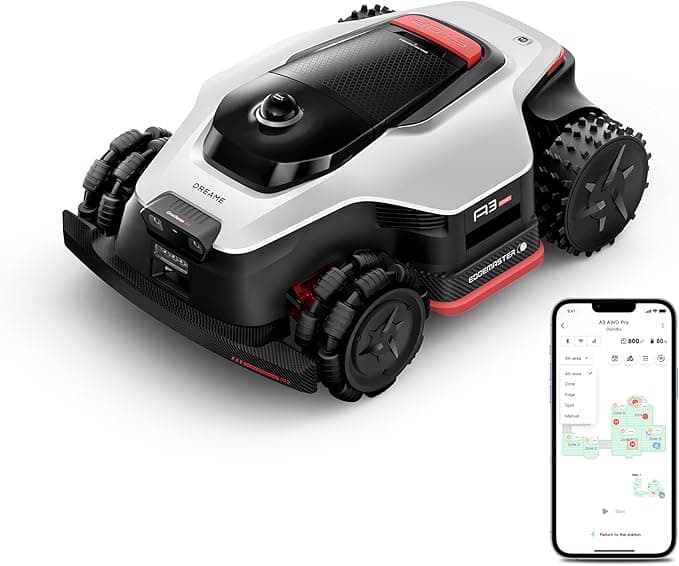
DREAME A3 AWD Pro 3500
The off-road reference for 5000m². 4-wheel drive, climbs trees (almost, 80% slope) and 3D vision.
Affiliate link. Same price for you.
LiDAR vs Vision: The Decision Framework
LiDAR or Vision for your garden?
The simulator considers your garden's specific constraints and recommends accordingly.
The choice between LiDAR and Vision is not about which is technically superior. It is about which failure mode is more acceptable for your garden.
LiDAR fails on: glass structures (greenhouses, conservatories), highly dynamic environments with frequent unclassified obstacles, and very dark-coloured featureless perimeters (rare, but solid black rubber borders cause occasional mapping issues).
Vision fails on: very low light conditions (early dawn or night sessions without garden lighting), reflective water surfaces in the mowing zone, and gardens where the visual landmark set changes significantly between seasons (a bare winter hedge versus a full summer one can confuse early-season navigation).
For a typical enclosed urban garden with no glass structures and no pets: LiDAR. For a suburban garden with dogs, children's toys, and moderate natural light: Vision. For a large complex garden with glass structures and slopes over 35%: Vision on an AWD model.
LiDAR vs Vision: 2026 Top Models
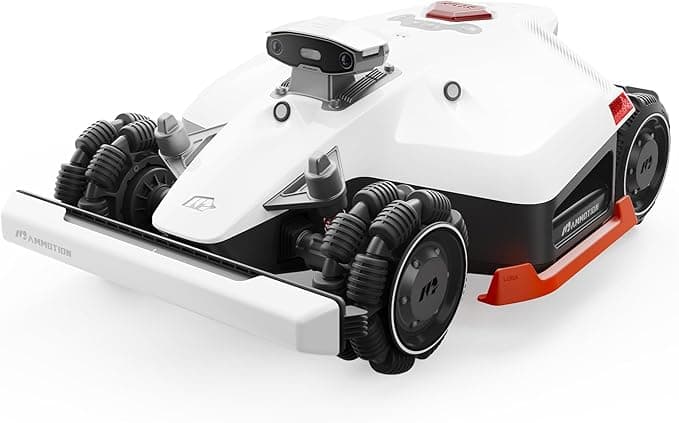 | | |
|---|---|---|
| Max area | 5000 m² | 3500 m² |
| Max slope | 80% | 80% |
| Wire-free | ||
| GPS / RTK | ||
| Cut-to-Edge | ||
| App control | ||
| Check price | Check price |
The Hybrid Approach
Several manufacturers now combine both technologies. The Mammotion Luba 2 AWD 5000 uses LiDAR for primary navigation and an additional camera sensor for obstacle classification. This addresses LiDAR's obstacle recognition weakness without giving up the precision and all-weather reliability of LiDAR navigation.
Hybrid sensor robots are more expensive (typically in the £1400 to £2000 range), but they remove the single largest limitation of each standalone approach. If budget allows and the garden justifies it, a hybrid model is the safest choice for complex gardens.
Practical Accuracy Comparison
In controlled testing conditions on a standard suburban lawn, LiDAR models typically achieve mowing coverage of 97-98% of the mapped area per session. Vision models achieve 94-96%, with the gap widening in changing natural light conditions. In both cases, coverage is significantly better than perimeter-wire models (typically 88-92%) because the navigation precision eliminates the uncut buffer zones that wire models leave near the perimeter cable.
LiDAR vs Vision at a Glance
Pros
- LiDAR: all-weather, GPS-independent, high precision mapping
- LiDAR: excellent in enclosed walled gardens
- Vision: real-time dynamic obstacle classification
- Vision: handles glass structures without blind spots
Cons
- LiDAR: glass surfaces create sensor blind spots
- LiDAR: no real-time object category detection
- Vision: reduced accuracy in very low light
- Vision: visual landmark confusion with seasonal change
Frequently Asked Questions
Can a LiDAR robot mower work in a garden with a glass greenhouse?
Which technology is better for a garden with pets?
Is a hybrid LiDAR and Vision robot worth the price premium?
Read also
.png&w=3840&q=75)
May 19, 2026
Small Urban Gardens: Which Wire-Free Robot Mower to Choose in 2026?
High walls, narrow paths, and a patio taking up half the garden. Urban lawns are the hardest terrain for robot mowers. Here is which navigation technology actually works when the sky is blocked.
May 5, 2026
Replacing Your Boundary Wire Robot Mower with a Wire-Free Model: The Transition Guide
The installation took a full weekend and cost 200 euros. Three years later you have repaired the wire four times. Here is how to move to a wire-free model without repeating the same headache.
.png&w=3840&q=75)
May 3, 2026
Winterising and Maintenance: 5 Steps to Double the Lifespan of Your Robot Mower
Most robot mower failures do not happen during the mowing season. They happen after a bad winter storage. Here is how to avoid the most costly mistakes.